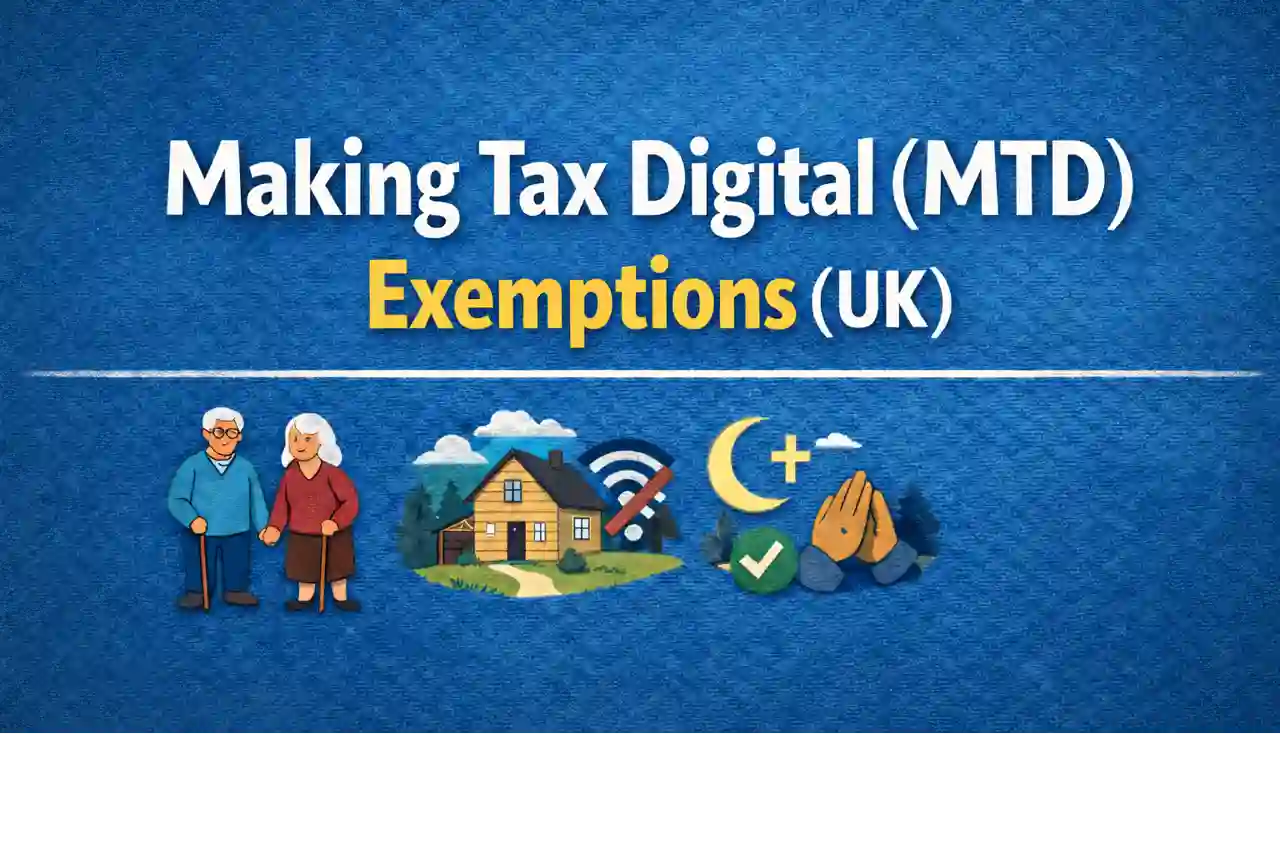
Making Tax Digital for Income Tax Self-Assessment (MTD ITSA) starting from April 2026,and many sole traders and landlords are asking the same question: do I actually need to join, or am I exempt?
This guide explains who MTD applies to, who is automatically exempt, when an exemption must be applied for, and what happens next
What is MTD ITSA?
MTD ITSA applies to sole traders and landlords with qualifying income from self-employment or property.
MTD start dates and income thresholds:
• From 6 April 2026: qualifying income threshold of £50,000+ (based on 2024/25 income)
• From April 2027: threshold reduces to £30,000 (based on 2025/26 income)
• From April 2028: threshold reduces further to £20,000.
Qualifying income means turnover before expenses from business and rental income.
It does not include employment income, pensions, or dividends.
Automatic exemptions from Making Tax Digital:
Some taxpayers are automatically exempt from MTD and do not need to apply to HMRC.
You are automatically exempt if:
• Your qualifying income is below the MTD threshold for that tax year
• You are a company (MTD does not currently apply to companies)
• You operate through a partnership or LLP (no start date has been confirmed yet)
• You do not have a National Insurance number by the relevant deadline.
• You are a trustee, executor, or personal representative (in that role only)
• You are a Lloyd’s underwriter, in respect of underwriting income.
• You are a foster or kinship carer with income only from qualifying care relief.
• You lack physical or mental capacity, and someone is legally authorised to act for you.
If you fall into one of these categories, MTD does not apply and no action is required.
Digital exclusion under Making Tax Digital:
You may qualify for an MTD exemption if it is not reasonably possible for you to use digital tools. HMRC may accept this where difficulties arise due to:
• Age
• Disability
• Location (for example, poor internet access)
• Religious beliefs preventing digital use.
What does not count as digital exclusion?
HMRC will not normally accept the following on their own as exemptions:
• Not feeling confident with technology
• Preferring paper records
• Concerns about software costs
• Having a small number of transactions
HMRC expects most taxpayers to adapt unless there is a clear barrier.
Important: Having an accountant does not automatically make you digitally excluded. If your agent submits information digitally using MTD-compatible software, you are usually considered compliant.
Time-limited MTD exemptions and deferrals:
Some taxpayers are temporarily exempt or deferred from MTD, even if their income exceeds the threshold.
You do not need to join MTD during the current Parliamentary term if you are:
• A minister of religion
• Receiving or transferring the Married Couple’s Allowance
• Receiving the Blind Person’s Allowance
• A Lloyd’s underwriter with other qualifying income
If this was shown on your 2024/25 tax return, no action is needed. Otherwise, an application must be made.
Those Deferred until April 2027:
If your qualifying income is over £50,000, you would normally join MTD in April 2026. You are automatically deferred until April 2027 if you:
• Receive income from trusts or estates.
• Claim averaging (for example, farmers, musicians, writers, and creatives)
• Claim qualifying care relief alongside another income source.
• File SA109 non-residence pages and expect to do so again.
If this was not included on your 2024/25 return, you must apply.
This exemption only covers 2026/27. Whether MTD applies from April 2027 depends on your 2025/26 income.
Temporary exemptions requiring an application:
You must apply for a temporary exemption until April 2027 if:
• Your income exceeds £50,000 and you expect to file SA109 non-residence pages
• You are a non-resident entertainer or sportsperson.
Approval removes MTD obligations for 2026/27 only.
How to apply for an MTD exemption:
Applications must be made directly to HMRC, either by phone or post. You or your accountant can apply.
HMRC usually requires the following information:
• National Insurance number
• Contact details
• Current filing method
• Explanation of why MTD is not reasonably practicable
HMRC aims to respond within 28 days. If an application is refused, you can appeal within 30 days with additional evidence.
What happens if HMRC accepts or rejects your exemption?
If your MTD exemption is approved you can continue filing traditional Self-Assessment returns. Exemptions are not permanent, and HMRC must be informed if circumstances change.
If your exemption is rejected you must comply with MTD from the relevant start date. HMRC has confirmed a light-touch penalty approach initially, but ongoing non-compliance may still lead to penalties.
How GM Accountants & Tax Consultants can help with MTD:
At GM Accountants & Tax Consultants, our team of qualified accountants helps sole traders and landlords across the UK with MTD, from exemption checks to software setup and ongoing compliance, at competitive and affordable prices. Please feel free to contact us for expert advice. If you are unable to visit our office, we can arrange a call at a time that suits you. For further information, email us at admin@gmtaxconsultants.co.uk or call us on 020 3773 4123.
Disclaimer:
The information provided in this blog is for general informational purposes only and does not constitute professional accounting or tax advice. As individual circumstances may vary, readers are advised to contact us directly for advice tailored to their specific financial or tax situation.