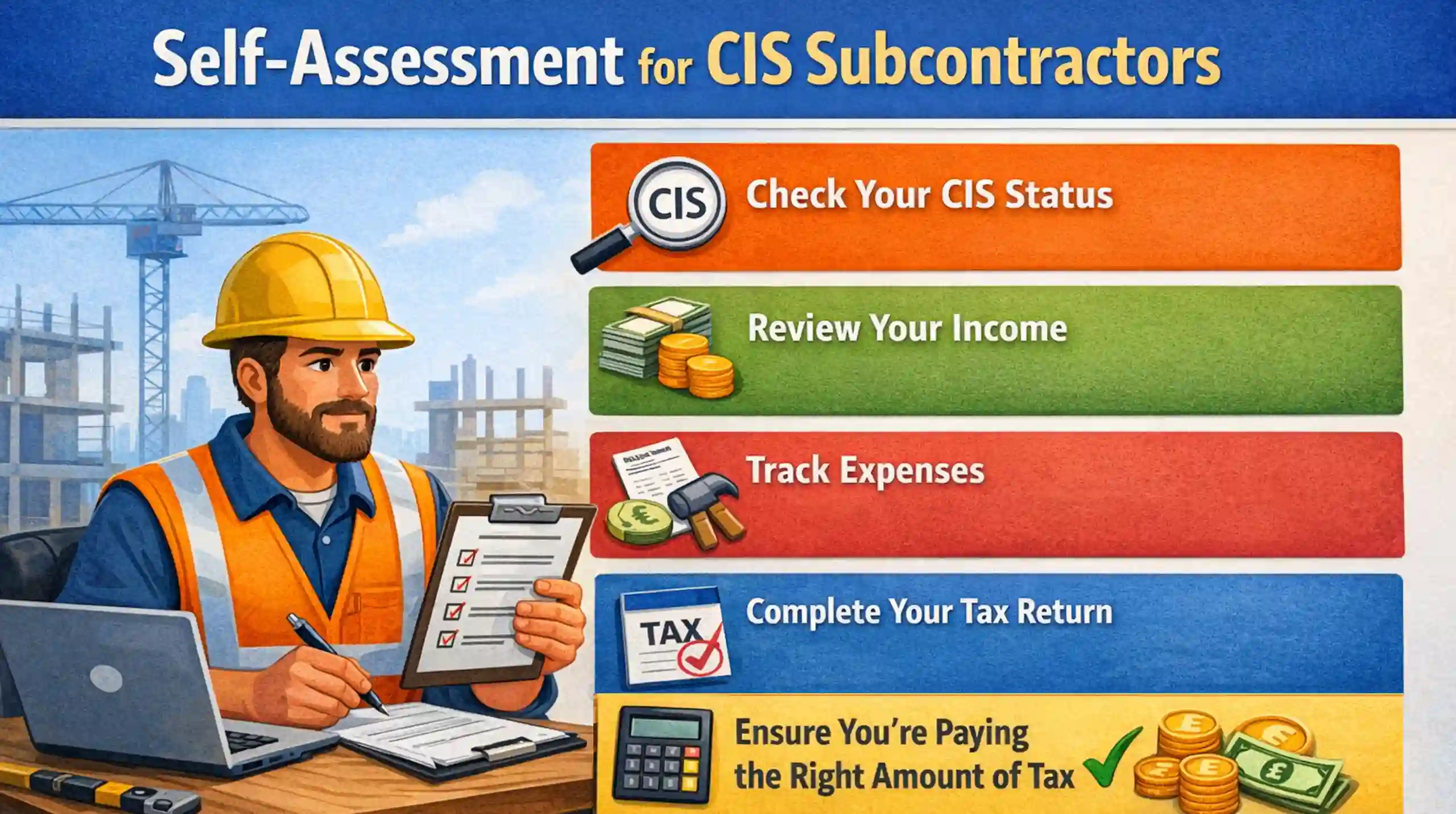
If you work as a CIS subcontractor, you will already be aware of how much tax can be deducted from your pay before it even reaches your bank account. Under the Construction Industry Scheme (CIS), tax is deducted at source by your contractor, often leaving you feeling financially stretched month after month.
Many subcontractors are unaware that they may have overpaid tax. After completing a CIS Self-Assessment tax return, a significant number discover they are entitled to a CIS tax refund.
This guide explains what CIS tax is, how deductions works, and how to complete your CIS tax return correctly — without confusion, unnecessary stress, or the risk of costly mistakes
What is CIS and how does it work?
CIS (Construction Industry Scheme) is HMRC’s system for collecting tax from the construction industry throughout the year, rather than waiting until the annual tax return is submitted.
While this is designed to make tax collection easier, it often means tax is taken before your real tax position is known.
CIS deductions do not consider:
- Your personal allowance
- Your business expenses
- Irregular working patterns
- Periods without work
This is why paying 20% CIS tax does not mean you owe 20% tax. Your CIS self-assessment exists to correct this and calculate your true tax liability. In many cases, this results in a CIS tax refund.
Do you need to file a CIS tax return?
Yes. If you have earned income as a CIS subcontractor, you must complete a Self-Assessment tax return.
Your CIS self-assessment tells HMRC:
- What income you earned
- What CIS tax was deducted?
- What expenses you incurred
- What tax you owe?
To complete your return, you will need:
- Your UTR number
- CIS deduction statements
- Invoices
- Mileage and travel records
- Receipts for tools, PPE, and equipment
- Accommodation costs
- Any other business-related expenses
Your return compares the tax already deducted with the tax you should have paid. If you have overpaid, HMRC will issue a CIS tax refund.
Deadline: 31 January
Missing this deadline results in an automatic £100 penalty, even if no tax is due.
CIS deductions explained
There are three CIS deduction rates, each affecting your income differently:
Twenty percent – Standard CIS deduction
This applies to registered subcontractors. Contractors deduct 20% from labour costs. This is the most common rate and the main reason many subcontractors are owed refunds.
Zero percent – Gross payment status
No tax is deducted at source. You are paid in full and settle everything through your tax return. This improves cash flow but comes with strict compliance rules.
Thirty percent – Not registered for CIS.
If you are not registered, contractors must deduct 30%. This is a significant loss of income and a strong reason to register as soon as possible.
What you can claim on your CIS tax return
Claiming expenses correctly can make a substantial difference to your tax bill and refund. Common allowable expenses include:
- Mileage and fuel
- Public transport
- Parking and tolls
- Tools, uniform, and PPE
- Work-related phone costs
- Accommodation for overnight work
- Trade insurance
- Accountancy fees
These reduce your taxable profit, which is why CIS refunds are so common.
How to complete your CIS self-assessment
A simple overview of the process:
- Log in to HMRC online services.
- Enter your total income.
- Add all CIS deductions from statements.
- Enter allowable expenses.
- Review the tax calculation.
- Submit your return.
- Wait for HMRC processing and repayment (if due)
Missing paperwork, statements, or receipts is extremely common. This is one of the main reasons subcontractors make mistakes or underclaim. Professional support ensures everything is submitted correctly and in full compliance.
Common CIS tax mistakes to avoid.
- Missing CIS deduction statements
- Incorrect income figures
- Not claiming allowable expenses
- Filing late
- Mixing PAYE and CIS income
- Declaring gross income instead of labour-only income
- Misunderstanding gross payment status rules
Avoiding these errors can increase your refund and prevent penalties or HMRC enquiries.
CIS tax refunds – how to get your money back.
Most subcontractors overpay tax under CIS. Once your CIS tax return is submitted, HMRC compares:
- Tax deducted at source
- Your actual tax liability
If you have overpaid, a CIS tax refund is issued.
Refunds commonly arise from:
- CIS deductions taken at source.
- Business expenses
- Periods without work
- Switching between CIS and PAYE
- Tools, travel, and accommodation costs
Need help with your CIS self-assessment?
CIS tax can be complex, and small mistakes can cost you money. We specialise in CIS self-assessment for subcontractors, ensuring:
- Accurate tax calculations
- Maximum allowable expense claims
- Full HMRC compliance
- Faster, stress-free submissions
- Optimised CIS tax refunds
If you want support with your CIS tax return
At GM Accountants & Tax Consultants, our team of qualified accountants can support and guide you with CIS Tax returns or a clear estimate of your refund, at competitive and affordable prices. For CIS contractors We have special offer you do not need to pay until you get your refund. Please feel free to contact us for expert advice. If you are unable to visit our office, we can arrange a video call at a time that suits you. For further information, email us at admin@gmtaxconsultants.co.uk or call us on 020 3773 4123.
Disclaimer:
The information provided in this blog is for general informational purposes only and does not constitute professional accounting or tax advice. As individual circumstances may vary, readers are advised to contact us directly for advice tailored to their specific financial or tax situation.